
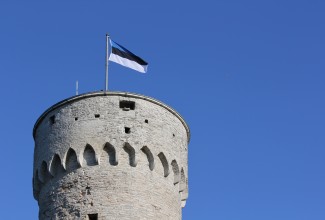
Flag-raising ceremony in Tallinn
The flag-raising ceremony has been held in the Kuberneri (Governor’s) Garden since 2004. The flag is raised at sunrise.
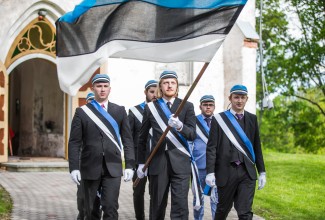
Procession and concert in Otepää
The anniversary of the Estonian flag has been celebrated in Otepää since 1884. Traditionally, there is a procession to the churchyard, a thanksgiving service and a concert in the evening.

Visiting the historic flag
After the opening of the new building of the Estonian National Museum in 2016, everyone can see the very first blue, black and white Estonian flag with their own eyes. Special flag-themed tours are organised on Flag Day.

Speaking event in Tartu
Tartu is the European Capital of Culture in 2024, and a speaking event will be held to celebrate the anniversary of our flag.

E-lesson: “What makes the blue, black and white flag cool?”
On the occasion of the anniversary of the flag, Secretary of State Taimar Peterkop will give an e-lecture outlining the exceptional nature of the Estonian flag to schoolchildren.

E-lesson: “Why should I raise the Estonian flag?”
On the occasion of the anniversary of the flag, Secretary of State Taimar Peterkop will give an e-lecture outlining the exceptional nature of the Estonian flag to schoolchildren.

Speaking event in Pärnu
The summer capital of Estonia will remember the Estonian flag with a speaking event.
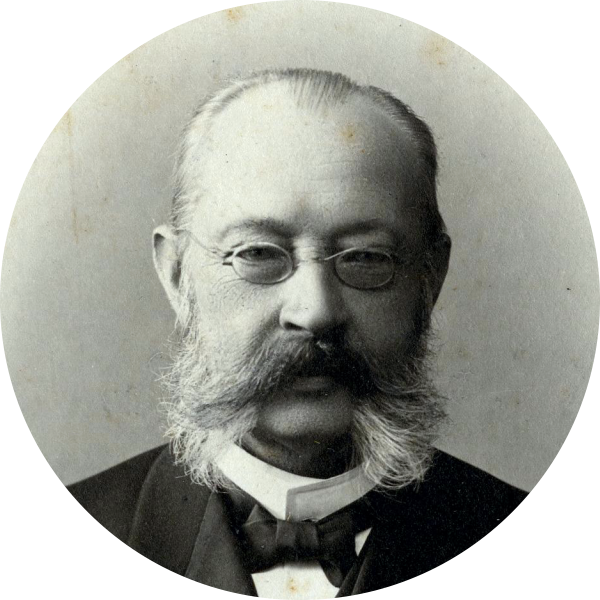
Let the world be full of devils, they’ll not beat our flag!
Heinrich Rosenthal
4 June 1884 in Otepää





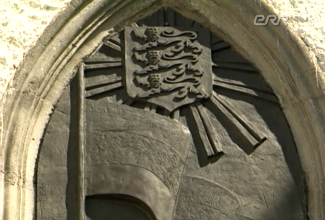
Story of our Flag
The 19th century saw a rise in self-awareness and the cultural awakening of the Estonian people. In 1870, eight Estonian students came together to read Kalevipoeg. This meeting blossomed into the first Estonian academic organisation: today’s Estonian Students Society.
On 29 September 1881, the students gathered in building no. 17 on Tähtvere Hill in Tartu, and started selecting their colours. The colours had to speak of Estonian nature, be in keeping with the colours of our folk costumes and stand out from the six existing student corporations. After hearing suggestions, the decision was made to select blue, black and white as the identifying colours.
Nothing definitive was written about the meaning of the colours. In general, blue represents the sky, but also the future and the truth; black represents the soil, the past and also love; and white represents the snow, spiritual light and hope.

The first blue, black and white flag was consecrated in the Otepää rectory on 4 June 1884. This trip of the Estonian Students Society to Otepää took place on the invitation of the local pastor, Burchard Sperrlingk. The guests were carrying the blue, black and white silk flag given to the society, which they were hiding. When the spire of the Otepää church came into sight, the flag was unfurled to fly in the wind.
The next day, the church hall hosted a powerful flag consecration and blessing ceremony: first the society’s chairman, Peeter Hellat, gave an opening speech; then the flag was consecrated by Rudolf Kallas, a pastor from Valga. Based on a Bible verse, he explained that just as a rod became a serpent when Aaron cast it down, a dropped pledge of allegiance becomes a dangerous thing for a pledge-breaker.
At the end of the consecration act, the initiator of the Kalevipoeg evenings, Heinrich Rosenthal, hammered a silver nail into the pole of the blue, black and white flag.

Since Estonians intellectuals were primarily members of the Estonian Students Society and it was they who collected folklore and antiquities, the colours of the society became known all over the country.
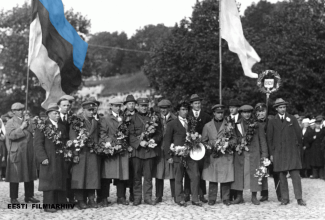
The most memorable use of these colours was at song festivals, exhibitions of the Estonian Farmers Society and the song days of choirs, as well as sports competitions and even at the 1912 Olympics in Stockholm. However, as russification gained momentum, the imperial authorities started obstructing all things national, including the use of these three colours. But this only served to further reinforce the national identity of Estonians and established blue, black and white as the national colours.
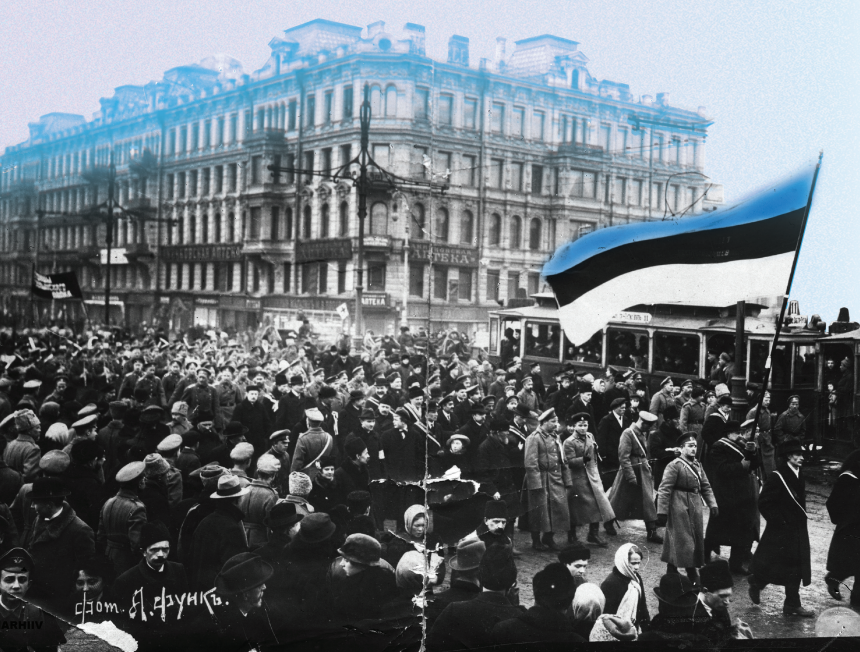
The most impressive display of the national flag took place on 26 March 1917 in Petrograd, when about 40,000 Estonians waving a huge number of national flags demanded autonomy for Estonia.
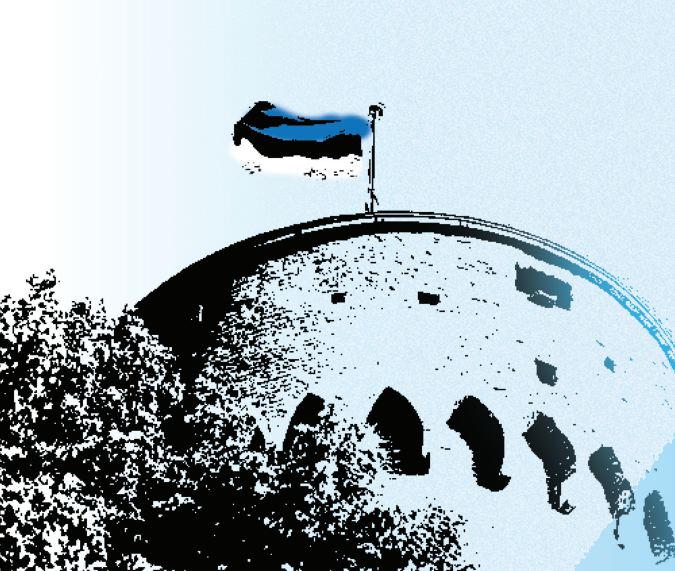
On 24 February 1918, the Republic of Estonia was declared under blue, black and white flags. On 21 November 1918, after the establishment of state authorities, the Provisional Government approved the blue, black and white national flag as the flag of the state. As a sign of Estonian power, the blue, black and white flag was hoisted on Tall Hermann Towner on 12 December 1918.
The State Flag Act was adopted by the Riigikogu on 27 June 1922. Following the adoption of this act, the procedures for the use of the state flag were specified and the government approved the special badges of public authorities and persons to be placed on the state flag.
The use of the blue, black and white flag was banned after the occupation of Estonia. The blue, black and white flew on Tall Hermann Tower again from 20-22 September 1944. In this way, the Estonian people expressed their desire for independence and protested against the further occupation of Estonia. The Soviet occupation of Estonia only came to an end on 20 August 1991.
The historic blue, black and white flag was deposited in the Estonian National Museum in 1934. When Estonia was occupied by the Soviet Union on 17 June 1940, the occupants started to demolish the Estonian constitutional order, and state institutions and social organisations were shut down. The use of national symbols was banned and the symbols of free Estonia were destroyed. The fate of the first blue, black and white was unknown.
On the eve of the flag’s 100th anniversary in 1984, a brochure was published in Toronto in which Karl Aun, the chairman of the Estonian Students Society in 1940, informed the public for the first time that the historic flag had been hidden. As early as in August 1940, the young Aun had replaced the first blue, black and white flag with a duplicate made in the Estonian National Museum in 1934.
Following the restoration of Estonia’s independence, the well-preserved flag was removed from its hiding place by the keepers of the secret in the presence of Estonian Television on 26 December 1991. Aun had preserved one of the most important relics of the Republic of Estonia on his father’s farm.
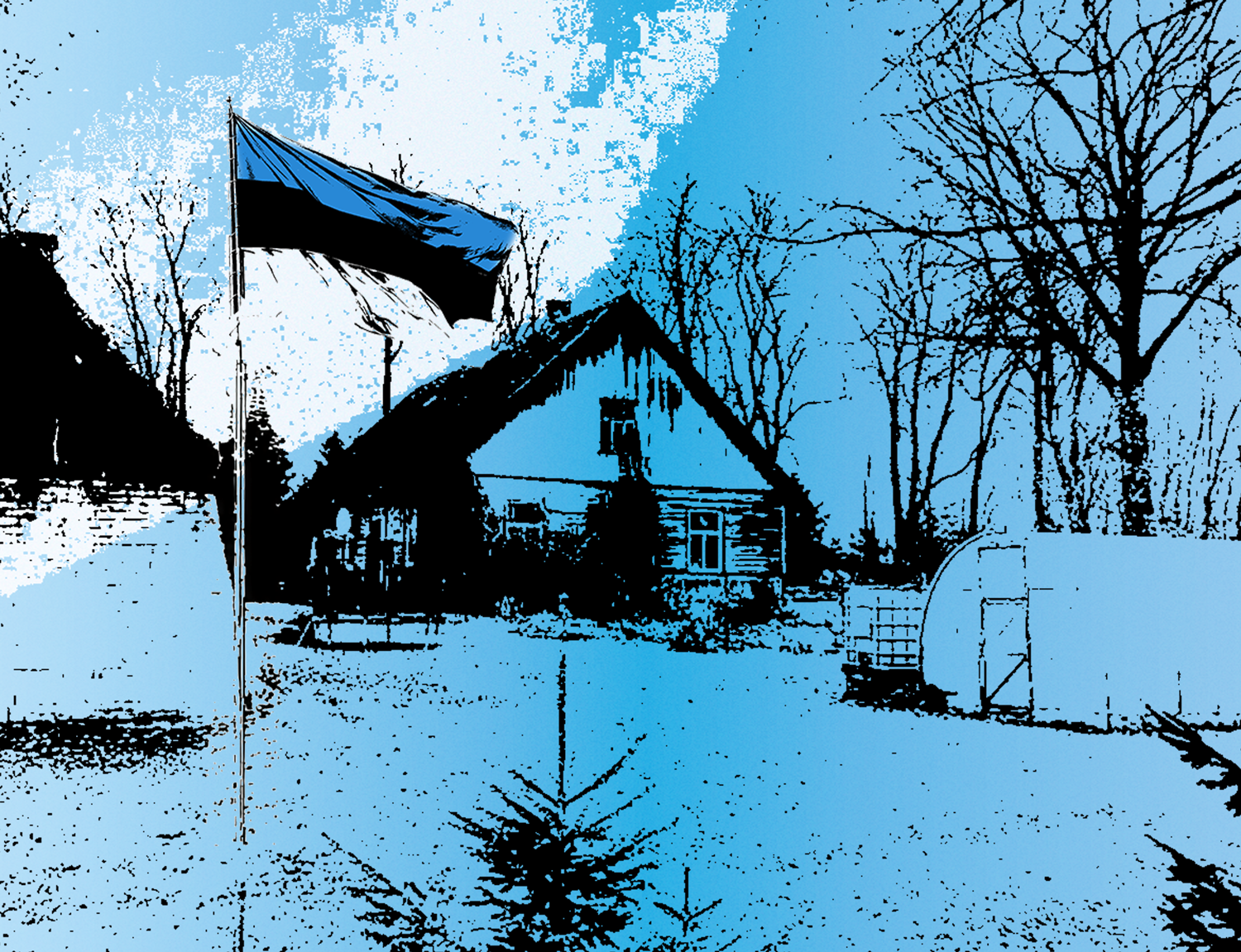
The blue, black and white flag was reborn as both the national and state flag when the independence of Estonia was restored. Its widespread use required the establishment of more detailed procedures, including fixing the colours of the flag.
The Riigikogu approved the design and procedure for the use of the state flag, and in 2005 merged the national and state flags to become the Estonian flag.

Emblem of the Anniversary

This emblem commemorating the anniversaries of the Estonian flag represents a fragment of a fingerprint, a bearer of identity. The blue, black and white fingerprint speaks of the Estonian state, its people, its culture and the thing that links them: the Estonian flag. The visual solution for the flag’s anniversary was created by the design agency Loovvool.
Use of the flag badge and its visual solution is free for all. The visuals can be used on condition that it is done with dignity and in accordance with the style guide. The Government Office does not consider it good practice for the visual solution marking the anniversaries of the flag to be used with products or events promoting casinos, alcohol or other intoxicants.
If you have any questions about the use of the flag badge or its visual solution, please contact the Government Office by e-mailing [email protected].
12 facts about the Estonian flag
Last updated: 05.06.2024

