
“Doctors, teachers, accountants, human resources specialists, musicians, translators, and many others will have more time to devote to meaningful work, learning, and interacting with people when they use artificial intelligence. Less time is spent searching for information, on paperwork, and on routine tasks. This also means more personal and family time,” said Michal.
“Artificial intelligence enables businesses to boost productivity and allows the government to provide faster and better services. Our ambition could also bring significant economic benefits to Estonia. If, in ten years, we are the European leader in the implementation of artificial intelligence, it could grow the economy by 1–2% a year, or by 400–800 million euros,” said the prime minister.
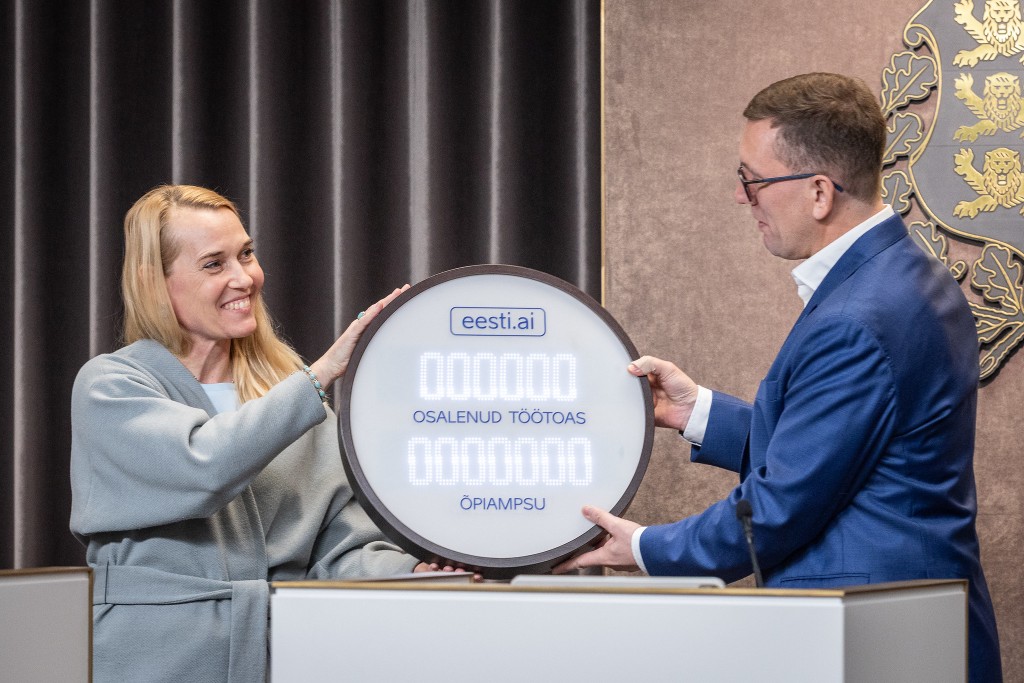
“No change happens by itself or overnight. Our goal is for at least 100,000 people across Estonia to take part in artificial intelligence workshops over the next 18 months. I encourage everyone to actively participate; the workshops are free for anyone interested,” said the prime minister.
According to Markus Villig, Chairman of the Eesti.ai council, the initiative focuses not only on strategic objectives but also on its practical impact. “We’re not just talking about artificial intelligence; we’re putting it to work for the benefit of people, the country, and businesses. “We have selected the first 15 projects that are making a real difference to the way people work, learn, and provide services,” said Villig.
Kirke Maar, Team Lead at Eesti.ai, said that the initiative focuses on people’s skills and broad-based involvement. “Estonians could become the world’s most AI-savvy people. This means skills, user-friendly tools and the opportunity for everyone to experiment with artificial intelligence in their work and everyday life. We want proficiency in artificial intelligence not to remain an advantage of the few, but to become a natural part of the knowledge and working lives of Estonians,” said Maar.
The first 15 pilot projects include initiatives in the fields of skills development, healthcare, entrepreneurship, the public sector, education, and infrastructure. For example, AI-based solutions are being developed for the information system used by family physicians and the e-emergency service to reduce the time spent on documentation and allow doctors more time to spend with patients. A key principle for all projects is that every initiative must create measurable value in terms of time, money, or quality.
As part of the Eesti.ai initiative, a series of practical workshops are being held across Estonia, the first of which takes place today in Tallinn. The next workshops will take place in Tartu, Jõhvi, and Pärnu. Further details about the workshops are regularly updated and can be found at Eesti.ai.
In addition, Eesti.ai invites people to submit suggestions via its public problem collection system regarding the areas of life and work where artificial intelligence could help solve problems and create added value for people and society. Suggestions, for example, on how artificial intelligence could reduce time consumption, improve the quality of services, streamline work processes, or help resolve any bottlenecks, are welcomed. Suggestions can be sent to [email protected].
You can find information about Eesti.ai projects here: Eesti.ai projektide nimiri.docx | 21.83 KB | docx
Photos from the first meeting of the council: https://www.flickr.com/photos/stenbockimaja/albums/72177720332965277

