
The day's first panel shed light on the critical issue of environmental defenders who put their lives on the line to protect our planet. UN Special Rapporteur on Environmental Defenders under the Aarhus Convention, Michel Frost, provided a sobering perspective: "Defenders don't become defenders by choice but by necessity. Sadly, we witness one killing of an environmental defender every other day. Not just that, they face death threats, harassment, violence, and discrimination, which stem from greed, a lack of political will from states, corruption, and powerful interests."
The Summit also focused on the importance of protecting civil society in times of democratic transition. Among the compelling narratives, Jessica Estrada, Director of Transparency and Anti-Corruption at the National Foundation for Development (FUNDE) in El Salvador called on the international community to support civil society organizations in countries where democracy is under threat. "We have been part of OGP for years, but in 2019, a new government came into power that refused to honour our action plan, leading us to leave OGP. It has been a painful journey for civil society," she said.
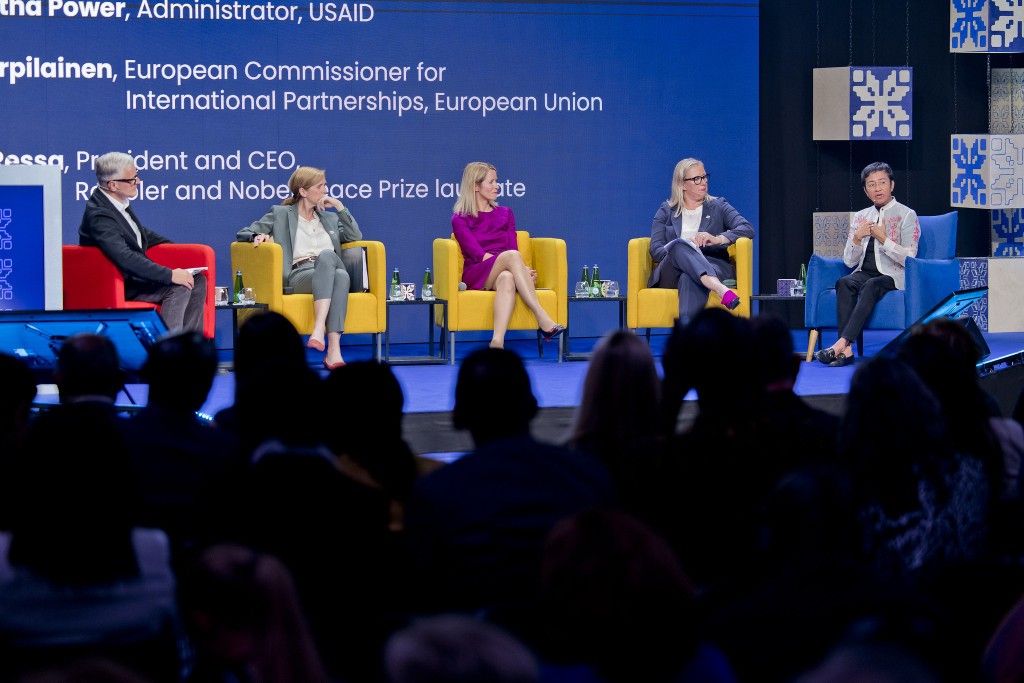
Participants could also enjoy a vibrant and thought-provoking discussion about the challenges of balancing national security with the need for transparency and accountability. Panel member Maria Ressa, who's CEO of Rappler and a Nobel Peace Prize winner, spoke about the importance of journalism in holding governments accountable. She pointed out how, with the decline of democracy, the role of journalists has changed. "Journalists now face harassment, threats, and even imprisonment for doing their jobs. For example, in 2019, in three months, I had eight arrest warrants against me, and I've done nothing other than be a journalist," she said. Ressa also brought out how technology, while a tool for empowerment, has been exploited for disinformation and surveillance capitalism, where it's become profitable to manipulate users. As a remedy, she recommended stopping surveillance for profit, stopping coded bias, and understanding that journalism is an antidote to tyranny.
The USAID Administrator Samantha Power joined the Summit to discuss the opportunities that technology can offer for open democracy and its transformative potential in governance. "Estonia's progress inspired e-governance innovation globally, notably in Ukraine where the Diia platform, launched in 2020, has empowered citizens to interact with their government digitally, from starting a new business to reporting war crimes. This platform has been transformative, preventing corruption and offering transparency," said Power.
The Administrator further announced exciting developments: "USAID will partner with Estonia and Ukraine's Ministry of Digital Transformation to expand Diia's model and digital public infrastructure to Colombia, Kosovo, and Zambia. Estonia's expertise in interoperability will make this adaptation to different systems possible."
In the final roundtable, Samantha Power also pointed out that we should focus on countries where progress is being made and support their efforts towards democracy. She stated, "When citizens raise their hands and commit to the hard work in a world where trust is lacking, they need to believe they can make a change. We often spend so much time concentrating on problem areas that we, the democratic world, miss the opportunity to provide support when it truly matters to build and validate trust, which is a fleeting commodity these days," she said.
The second day of the OGP Global Summit reaffirmed the importance of open government, the resilience of civil society, and the pivotal role of technology in shaping the democracies of tomorrow. All those around 50 sessions that were held in two Summit days emphasized that, despite challenges, the global community remains committed to enhancing accountability, transparency, and citizen engagement on a digital frontier.
Estonia assumed the role of government chair of the Open Government Partnership (OGP) Steering Committee in October 2022 together with the civil society co-chair Anabel Cruz, Founder and Director of the Communications and Development Institute in Uruguay.
The OGP Global Summit also concluded their terms as Co-Chairs. They will be succeeded by the Government of Kenya and Blair Glencorse, Co-CEO of Accountability Lab. They will chair the OGP Steering Committee for one year starting October 1, 2023.
The 8th Open Government Partnership (OGP) Global Summit brought together over 2000 people from around 130 countries, including heads of state and government, civil society organizations, and policy-makers.
Photos of the OGP Global Summit can be found here: https://www.flickr.com/photos/opengovpart/albums

